Guide · Roof + Solar
Solar panel removal and reinstall in Tampa Bay.
Your roof needs replacing and there is an array sitting on it. Here is exactly how a detach and reset works in Florida, where the warranty traps are, and why splitting the job between two companies is the expensive way to do it.
Solar panel removal and reinstall: the short version
- A full roof tear-off means the whole array comes off — panels, rails, mounts and penetrations.
- Plan on the system being offline about a week on a typical single-family home.
- Removal and reinstall is priced per panel plus the electrical scope, not as one flat fee.
- The workmanship warranty on the roof penetrations is the thing to nail down in writing first.
- One licensed company on both the roof and the mounts removes the leak-blame problem entirely.
Why this comes up so often here.
A lot of Florida homes went solar on a roof that already had ten or fifteen years on it. Sun, storms, and salt air do the rest. When the roof finally fails — or an insurer refuses to renew until it is replaced — the array becomes the complication nobody planned for.
The work itself is routine. The problems are almost always organizational: two contractors, two schedules, and two warranties that stop at each other's edge. The single biggest thing you can do to keep this simple is to have one licensed company responsible for both the roof and the mounts that penetrate it.
How a detach and reset runs.
- 01
Site walk
We look at the array, the racking type, the roof deck, and the electrical service, then tell you whether the roof genuinely needs replacing or has years left.
- 02
Shutdown and detach
The system is shut down properly at the inverter and disconnect. Panels, rails, and mounts come off and get labeled and stored on site.
- 03
Roof replacement
Tear-off, decking repairs, dry-in, and the new roof — planned around where the array is going back so the mounts land on solid structure.
- 04
Reinstall and reflash
Mounts go back with new flashing, rails are re-set, panels return to their planned layout, and wiring is redressed rather than reused as-is.
- 05
Recommission
The system is energized, production is verified, and monitoring is confirmed reporting before we call it done.
What drives the price.
Removal and reinstall is quoted per panel plus the electrical scope. These are the variables that move the number on a Tampa Bay home, and the ones we walk before putting anything in writing.
| Factor | Why it matters |
|---|---|
| Array size | Detach and reset is largely per-panel labor. A 12-panel system and a 40-panel system are not the same afternoon. |
| Racking and mount type | Rail-based systems on comp shingle come apart cleanly. Older ballasted, tile, or direct-mount hardware takes longer and often needs new parts. |
| Roof type and pitch | Tile and metal need different flashing details than shingle, and a steep or two-story roof adds staging and fall protection. |
| Electrical scope | Whether conduit, home runs, and the disconnect get re-run or reused, and whether the inverter or optimizers are old enough to be worth swapping while the array is down. |
| Storage | Panels crated and kept safe on site or hauled to our shop when the roof will be open for more than a few days. |
| Permits and inspections | The roof permit plus, in most jurisdictions here, an electrical or PV permit for the reset — pulled and closed out by us. |
Removal and reinstall by roof type.
What the roof is made of changes the labor, the flashing details, and how long the array stays down. These are the four we see across Tampa Bay.
Asphalt shingle
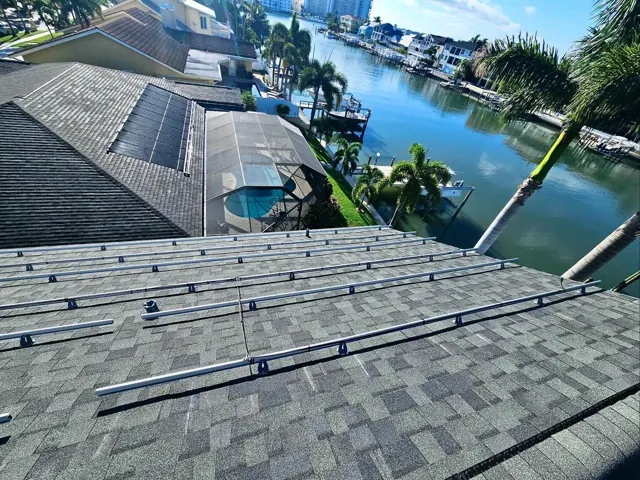
Simplest detach and reset
Rail-mounted arrays on shingle come apart cleanly. Mounts are replaced and re-flashed into the new shingle courses, which is the fastest and lowest-cost version of this job.
Tile (concrete or clay)
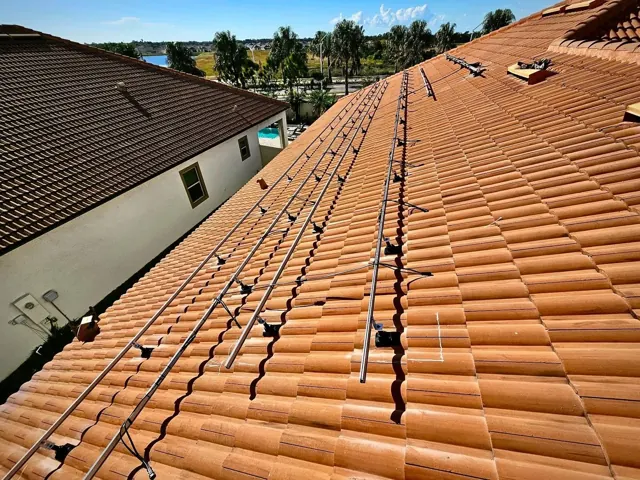
Slowest, most breakage
Tiles have to be lifted and set aside around every mount, and some always break. Reinstall uses tile hooks or replacement flashing pans, and sourcing matching tile can add days.
Metal standing seam
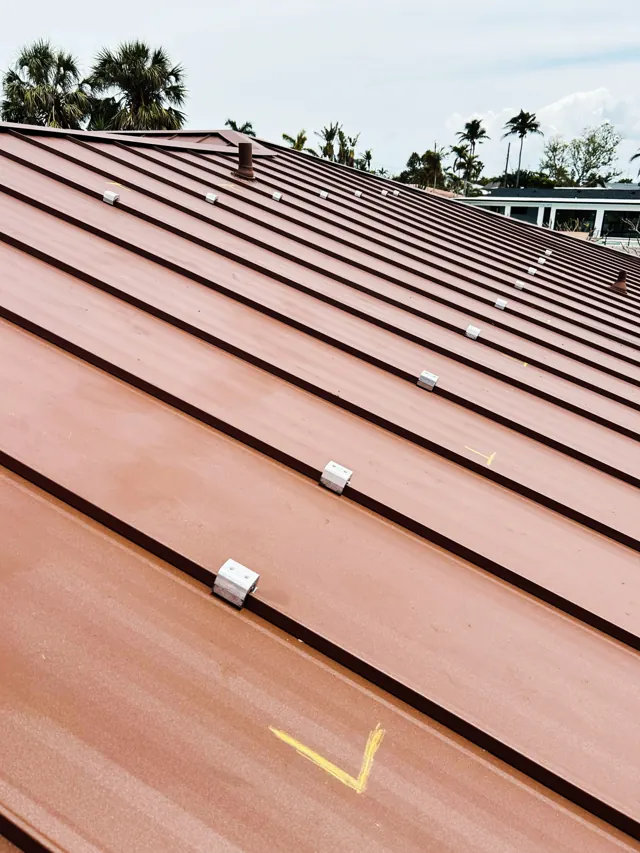
Often no new penetrations
Clamp-mounted arrays on standing seam usually come off without new holes, so the reset is clean. Exposed-fastener metal is closer to a shingle job and needs fresh sealed penetrations.
Flat / low-slope
Ballast and membrane care
Ballasted and low-slope systems mean protecting the membrane during teardown and re-setting ballast or attachments to the new roof assembly, usually with the membrane manufacturer's detail.
Which version of this job you have.
“Removal and reinstall” covers four fairly different scopes. Naming yours up front is what keeps the quote honest.
- Roof replacement under an existing array
- The common one. Array comes down, roof goes on, array goes back up on new flashing and is recommissioned.
- Storm or insurance claim
- The detach and reset has to appear in the adjuster's scope to get paid for. Send us the estimate and we will tell you whether the array work is actually in it.
- Removal only
- Selling, demolishing, or scrapping an old system. Panels come down, penetrations are sealed and roofed over, and the electrical is safely decommissioned.
- Panels from a previous home
- Reinstalling an array you already own on a different roof. Feasible, but the layout, structure and interconnection all get re-engineered rather than reused.
Where we do detach and reset work.
Crews run out of Tampa across Hillsborough, Pinellas, Pasco and Polk, and out to Orlando and the Space Coast. A few of the areas we work most:
The warranty trap, in one paragraph.
Manufacturer warranties cover the hardware. Workmanship warranties cover the holes in your roof. When a third party detaches an array, the original installer's workmanship coverage on those penetrations frequently ends — and the roofer's warranty may exclude anything mounted through the new roof. That gap is where leaks turn into arguments. Before signing anything, ask both companies, in writing, who covers a leak at a mount two years from now.
Useful background reading: the U.S. Department of Energy's homeowner guide to going solar and the Florida Building Code, which governs how the roof and its attachments have to be detailed.
Detach & reset
Roof under an existing array?
Tell us the roof age and what is on it. We'll tell you whether it needs replacing now and what a combined roof-and-solar sequence looks like.
Question 1 of 4
Is this a home or a business?
So we send the right crew.
Questions we get.
Do solar panels have to come off to replace a roof?
Yes. A full tear-off means every panel, rail, and roof penetration has to come off the deck and go back on after the new roof is dried in. Partial repairs away from the array can sometimes be done without a full detach.
How long are the panels off the roof?
On a typical single-family home the array comes down in a day, the roof goes on over the following days, and the reinstall and reconnection follow once the roof passes its inspection. Plan for the system to be offline for roughly a week, sometimes less.
Will removing my panels void the warranty?
That is the real risk. Panel and inverter manufacturer warranties usually survive a professional detach, but the original installer's workmanship warranty often does not follow work done by someone else. Get in writing who covers the roof penetrations after the reinstall before anyone starts.
Who is responsible if the roof leaks at a mount after reinstall?
Whoever set the flashing. When a roofer and a separate solar company split the job, that answer gets blurry fast. We do both trades in-house specifically so there is one name on the roof and one name on the mounts.
How much does it cost to remove and reinstall solar panels?
It is priced per panel plus the electrical work, and the spread is wide: array size, racking type, roof pitch and height, how many strings have to be re-run, and whether any mounts or optimizers need replacing. We quote the detach and the reset as line items alongside the roof so you can see exactly what the array is adding, rather than one blended number.
Is detach and reset the same as removal and reinstall?
Same job, different words. Roofers and insurers tend to say detach and reset; solar companies say removal and reinstall or uninstall and reinstall. All of them mean taking the array down, replacing the roof, and putting the system back up and back online.
Does insurance or a roof claim cover the solar removal?
Sometimes. When a roof is replaced under a storm claim, the detach and reset line is often part of the scope — but it has to be documented and priced in the estimate. Send us the adjuster scope and we will tell you whether the array work is actually in it.
Do I need a permit for detach and reset?
Usually yes — the roof replacement needs one, and many Florida jurisdictions also require an electrical or PV permit for the reset. We pull and close out both rather than leaving you to chase them.
Should I upgrade equipment while the array is down?
It is the cheapest moment to do it. If your inverter is aging, you want to add a battery, or the original layout was poor, the labor is already paid for. We flag it during the walk instead of after the panels are back up.
What if my roof is fine but I still want more panels?
Then no detach is needed — we add to the existing array if the roof plane, the electrical service, and the interconnection allow it. The site visit tells us which case you are in.